
IB Math AAHL Exam Strategy: Different Approaches to Paper 1, Paper 2, and Paper 3 (From a Math AAHL Graduate)
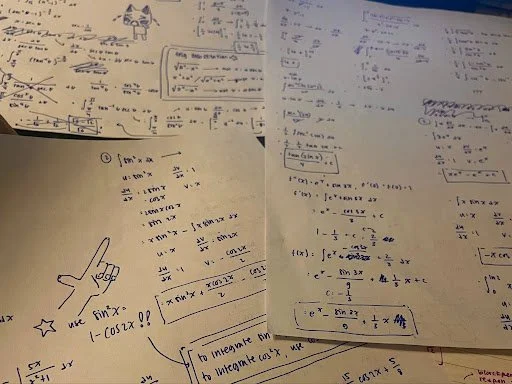
Known as one of the most challenging subjects in the IBDP, it is safe to say that the Mathematics Analysis and Approaches HL exam requires days, or even months of preparation. One common mistake that students make, however, is letting all those preparations go to waste, by not understanding how to approach each paper. In this blog, I will explain how adapting the correct approach to each paper has helped me gain a 7, and a near perfect score.
Paper 1: Non-calculator
Within the time limit of 2 hours, Paper 1 is mostly aimed to test students’ fluency in algebraic methods (since calculators are not allowed), as well as theoretical understanding in topics such as trigonometry, series, and calculus (often asking students to do proofs).
Because of this, mistakes that students make often revolve around small algebraic errors, especially with derivation-heavy questions such as the following:

Figure 1. Trigonometry problem from Mathematics: AA HL Paper 1 TZ3 May 2025. Source: International Baccalaureate Organization (2025).
Here’s how students can strategize in tackling Paper 1:
Make use of the given time. Most students usually finish their paper way earlier than the 2 hours given, so it is better to work slowly on the questions; double-checking every step (especially on proofs and lengthy calculations. / long calculation questions)
Always keep answers and do calculations in exact form (fraction, not decimal, unless otherwise stated). This will not only save time, but also keep the answer precise.
Paper 2: Calculator
Now similar to Paper 1, students will also be given 2 hours to complete Paper 2. It is designed to mostly test students’ skills in utilizing their GDC (Graphic Display Calculator), primarily in graphing, finding intersections, or using statistical functions. Based on this, Paper 2 mostly covers topics such as functions, statistics, and calculus.
Since calculators are allowed in this paper, one common mistake that students make is becoming overly reliant on their calculator, and end up spending too much time. It is also worth noting that paper 2 questions are usually longer than those in Paper 1, despite having the same time limit.
To strategize effectively, here are some useful methods:
Try to not use a calculator / GDC, unless it is really necessary. For example, solving a differential equation problem like the following can take way more time if solved using a GDC. Therefore, solving by hand is heavily advised (GDC may be used at the end, to calculate the final answer after lots of simplification).
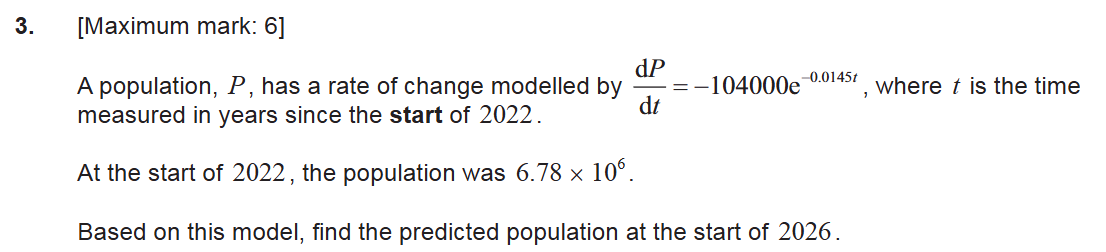
Figure 2. Differential equation problem from Mathematics: AA HL Paper 2 TZ1 May 2025. Source: International Baccalaureate Organization (2025).
Given the length of the paper, it is best to skip difficult questions initially (or putting marks on them), then go back once you’re done with the rest of the paper.
Paper 3: Calculator
Out of all the three papers for Math AAHL, Paper 3 is usually considered the most challenging, due to the unfamiliar concepts, multi-step, extended problems (as it is only composed of 2 questions), and shorter time limit of 1 hour.
Due to the nature of the paper, students often feel overwhelmed the second they see the questions, as there is a very high chance that it is different from what they had seen from reviewing past papers, or even from the other papers of the assessment (Paper 1 and 2).
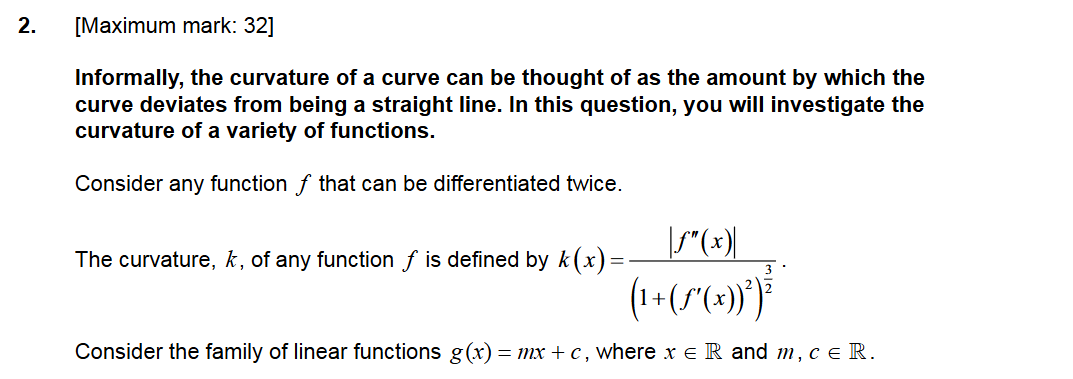
Figure 3. Advanced calculus problem from Mathematics: AA HL Paper 3 TZ1 May 2025. Source: International Baccalaureate Organization (2025).
To avoid losing marks on this paper, here are the best strategies for tackling Paper 3:
Attempt all subquestions, regardless of familiarity with the topics, as students will be given partial / method marks.
Follow the structure of the main question. When it comes to Paper 3 topics, students are expected to follow the structure of the main question (i.e. the subquestions are meant to be done in order, since they always correspond to the preceding ones), which means that it will most likely provide clues in answering the following questions.
Exam success is all about building exam strategies. When it comes to Paper 3, try to answer everything as fast as possible, as students often run out of time during Paper 3. It is also advisable to do timed practice with past papers.
Final note
In the end, securing a 7 in IB Math AAHL comes down to understanding topics well and doing the right strategy. By treating each paper differently, depending on how they are designed to test you, you’ll start to transform this rigorous exam into a manageable series of challenges. Master these distinct strategies, stay resilient through the difficult questions, and you will be on the right track to a top score.
At Kokusaba, we offer tutoring support, with experienced tutors tailored specifically to IB Analysis and Approaches, helping students refine their analysis and approach exams with confidence. Contact us to learn more!
